Table of Contents
- How to Get Into Motocross as a Kid: The First Year in Three Steps
- What Motocross for Kids Costs — and What Drives the Number
- Where Can Kids Ride Dirt Bikes?
- The First Dirt Bike: Fit Comes Before Displacement
- The Electric On-Ramp Most Parents Don't Know About
- Two-Stroke or Four-Stroke for a Kid?
- Gear That Matters and Gear That Can Wait
- Your First Day at a Motocross Track
- The Part Where You're Scared
- How Not to Become the Parent Everyone Avoids
- Racing Is Optional
- Where Coaching Fits
- What Year One Looks Like When It Goes Well
- Your Next Step
- FAQs
Your kid asked for a dirt bike. Maybe they saw a video, maybe a friend down the street has one, maybe they've been asking every weekend since spring. You said yes — or you're close to saying yes — and now you're staring at a search bar with no idea what the next step even is.
That gap is where most families stall out. Saying yes is the easy part. What comes after is a stack of questions nobody hands you an answer sheet for: what bike, what size, what gear, where are we even allowed to ride, what is this going to cost, and how do we do all of it without our kid getting hurt.
This guide walks the first year in the order you'll hit it. More than 20,000 riders have come through The Moto Academy's camps and classes, and plenty of them are kids whose parents started exactly where you're standing. What follows is the sequence those families tell us they wish someone had handed them on day one.
How to Get Into Motocross as a Kid: The First Year in Three Steps
Before the details, here's the shape of it. Most families who have a good first year follow roughly this order, and most families who have a rough one skip step one.
- Step 1 — Get your kid seat time before you buy anything. A rented or borrowed bike at a class tells you in one afternoon what six weeks of research can't: whether they love it, and what size fits them.
- Step 2 — Buy the bike that fits them today. The bike they'll grow into costs you a season of confidence, and confidence is what keeps a kid coming back.
- Step 3 — Put coaching in front of horsepower. Money spent on a faster bike or aftermarket parts buys a fraction of the progress the same money buys in instruction. At a Moto Academy camp there's one coach for every ten riders, and about 72% of riders come back for another camp or class.
Everything below expands on those three. Read it in order the first time, then come back to the sections you need.
What Motocross for Kids Costs — and What Drives the Number
Nobody in this sport likes to answer this question directly. We can't hand you a single figure honestly, because the number swings enormously by region, by how often you ride, and by how much wrenching you do yourself. What we can do is show you exactly what you'll be paying for, so you can price your own version in an afternoon.
What you pay once
The bike is the big line item. A used 50cc or 65cc in good condition is the most common entry point, and buying used is the norm rather than a compromise — kids outgrow these machines in a couple of seasons, so the used market is deep and turnover is fast.
Then there's gear. A full set for a small rider — helmet, goggles, boots, gloves, knee protection, chest protector — is a meaningful second purchase on top of the bike. Buy the helmet new. Helmets are built to absorb one significant impact, and a used one carries a history you can't inspect.
What you pay again and again
This is the part that surprises people. Track entry for a practice day is modest on its own, but it lands every single time you ride. Add fuel for the bike and fuel for the vehicle hauling it, and a routine weekend has a cost before anything breaks.
Then there's maintenance: oil, air filters, chains and sprockets, tires, brake pads. Dirt bikes are consumable machines. A kid's 65 ridden a couple of weekends a month needs attention on a schedule, not just when something goes wrong.
What's optional
Racing is where the numbers climb hardest — entry fees, travel, lodging, and the maintenance load that comes with riding a bike much harder. Plenty of families ride for years and never enter a race.
How to price your own version
Call the nearest track and ask what a practice day costs for a youth rider. Search local listings for used 50s and 65s and watch what they sell for, not what they're asking. Price a full set of youth gear at one shop. Those three numbers, added to a realistic guess at how many weekends you'll ride, will get you closer than any national average.
If cost is the thing standing between your kid and a camp, look at the Moto Academy Scholarship before you rule it out. It covers 35% of 5-Day Camp tuition for households under $80,000 a year and 50% for households under $60,000. It's need-based with no merit requirement, and there are up to five awards per camp.
Where Can Kids Ride Dirt Bikes?
This is the question that stops more families than bike shopping does, and almost nobody researches it before buying. A dirt bike in the garage with nowhere legal to ride it is an expensive lawn ornament.
Riding on public roads and sidewalks is illegal in nearly every city and state. Backyard riding in a residential neighborhood is restricted in a lot of places too — usually through noise or nuisance ordinances rather than an explicit dirt bike ban, which is why people are often caught out by it. Check your town's rules before you assume the yard is an option.
For most families, the realistic answers are these:
- A motocross track with open practice days. The most common option, and the one that puts your kid around other riders and adults who know the sport.
- An OHV park or riding area. Public land set aside for off-highway vehicles, often with trails and beginner sections.
- Private land, with explicit permission. A relative's farm or a friend's acreage, which is how a lot of riders start.
- A riding club. Membership-based access, often with organized youth days.
Call ahead the first time regardless of which you pick. Ask about minimum age, whether there's a beginner area or a separate small-bike track, and which days are quietest. A first session on an empty beginner loop is a completely different experience from a first session sharing a full-size track with fast adults.
The First Dirt Bike: Fit Comes Before Displacement
The most common mistake in this sport is buying a bike a kid will grow into. It comes from a good instinct — you don't want to buy twice — and it backfires almost every time.
A bike that's too tall means your kid can't get a foot down confidently at a stop. A bike with too much power means the throttle is frightening rather than useful. Both produce the same outcome: a kid who rides tense, progresses slowly, and starts finding reasons not to go to the track.
Size the bike to the rider standing in front of you. The birthday is the least useful number in the equation. The practical test is standover height — with the bike upright, can they get the balls of both feet to the ground? Can they reach the brake lever and squeeze it without shifting their grip? Can they pick the bike up off the ground themselves after a tip-over? That last one matters more than parents expect, because a kid who can't right their own bike is a kid who stops riding every time they fall.
Age charts are a starting point at best. Two ten-year-olds can be eight inches apart in height, and the shorter, more cautious one needs a different bike than the taller one who's already comfortable. Where a rider sits in their own progression matters as much as the number of candles on the cake.
Bikes families commonly start on
These come up constantly in beginner conversations. The Moto Academy has no sponsorship or affiliate relationship with any of these manufacturers and isn't recommending a particular machine — this is simply what the entry-level landscape looks like:
- Automatic 50cc machines — the Yamaha PW50 and Honda CRF50 are the classic first bikes. No gears to think about, low seat height, gentle power.
- Competition 50s — the KTM 50 SX and its siblings are faster and more race-oriented, suited to a kid who's already comfortable and wants to progress.
- Small four-strokes — the Honda CRF110 and Yamaha TT-R110 are heavier and slower-revving, with smooth, forgiving power that a lot of new riders get along with.
- 65cc two-strokes — the next step up, with a manual clutch and full-size motocross suspension. This is where most kids who stick with the sport end up.
And here's the step almost everyone skips: don't buy the bike until your kid has ridden one. A single coached day on a bike you didn't purchase answers the size question, the interest question, and the "are they going to like this" question at the same time. Some 5-Day Camps also offer bike rentals, which is another way to find out before you commit.
The Electric On-Ramp Most Parents Don't Know About
If your kid is somewhere in the three-to-six range, or is nervous about the whole idea, there's a rung on the ladder that didn't exist a decade ago and that most first-year parents have never heard of.
Electric balance bikes — the STACYC-style machines you'll see at tracks and increasingly in bike shops — have no pedals and no gears. They're throttle-only, with selectable power modes that let you cap the speed while a young rider figures out balance. Many can be run unpowered at first, so a kid learns to push, coast, and balance before any motor is involved.
What makes them useful is that the controls map directly onto a dirt bike. Twist to go, squeeze to stop, look where you want to end up. A kid who's spent a season on one arrives at their first gas bike already understanding throttle control and balance — the two things that take longest to learn and are least fun to learn while also being intimidated by noise and vibration.
They're quiet enough for a driveway or a park, which partly solves the "where do we ride" problem for the youngest riders. If you're at the very start of this and your kid is small, this is often the cheapest, lowest-stakes way to find out whether the interest holds.
Two-Stroke or Four-Stroke for a Kid?
You'll hit this fork around the 65cc and 85cc stage, and you'll get strong opinions from every direction. Here's the straight version.
Two-strokes are lighter, simpler, and cheaper to work on. They have a manual clutch and a narrow powerband, so a rider has to learn gear selection, clutch control, and how to carry momentum. That's harder at first and builds better habits. The tradeoff is more frequent scheduled maintenance — top-end rebuilds are routine preventive work rather than a sign something went wrong — and premix oil, which gets blended into the fuel on every fill.
Four-strokes deliver power lower down and more predictably, which makes them forgiving for a new rider. They're heavier, which matters a lot for a small kid picking the bike up. Maintenance intervals are longer, but the work is more involved and more expensive when it comes due.
For a first bike, forgiving power usually wins. For a kid who's riding regularly and starting to push, the two-stroke's demands tend to produce a sharper rider. There's no wrong answer here — there's only the bike your kid can control today.
Gear That Matters and Gear That Can Wait
Buy protection first and style later. Your kid will want the graphics that match their favorite rider, and that's fine, but the order of operations matters.
- Helmet — certified and correctly fitted, bought new. This is the one place not to economize. A helmet that's too big moves on impact and protects less than a properly fitted cheaper one.
- Goggles — dirt and roost (the spray of dirt thrown up by the bike ahead) go straight at the eyes. Non-negotiable from the first ride.
- Boots — motocross boots, which are stiff through the ankle and shin. Work boots and hiking boots don't do this job.
- Gloves — grip and blister prevention as much as protection.
- Knee protection — knees take impacts in low-speed tip-overs, which is exactly what a beginner does most.
- Chest protector — guards against roost and impact, and most young riders wear one.
- Neck brace — optional, and many families choose to add one.
What can wait: a second set of graphics, an upgraded exhaust, aftermarket suspension, a bike stand that costs more than the tires. Experienced parents will tell you the same thing repeatedly — fresh tires, a clean air filter, correct fuel, and coaching do more for a young rider than any performance part on the shelf.
Your First Day at a Motocross Track
Nobody explains this part, so families show up unsure where to park, what to sign, or when their kid is allowed on the track. Here's the shape of a normal practice day.
You'll sign in and sign a waiver — bring ID, and if you're not the legal guardian, find out in advance what paperwork the track needs. Sessions usually rotate by bike size or ability, and you'll be told which group your kid rides in and roughly how long each session runs. Between sessions, everyone comes off the track and the next group goes out.
What to bring
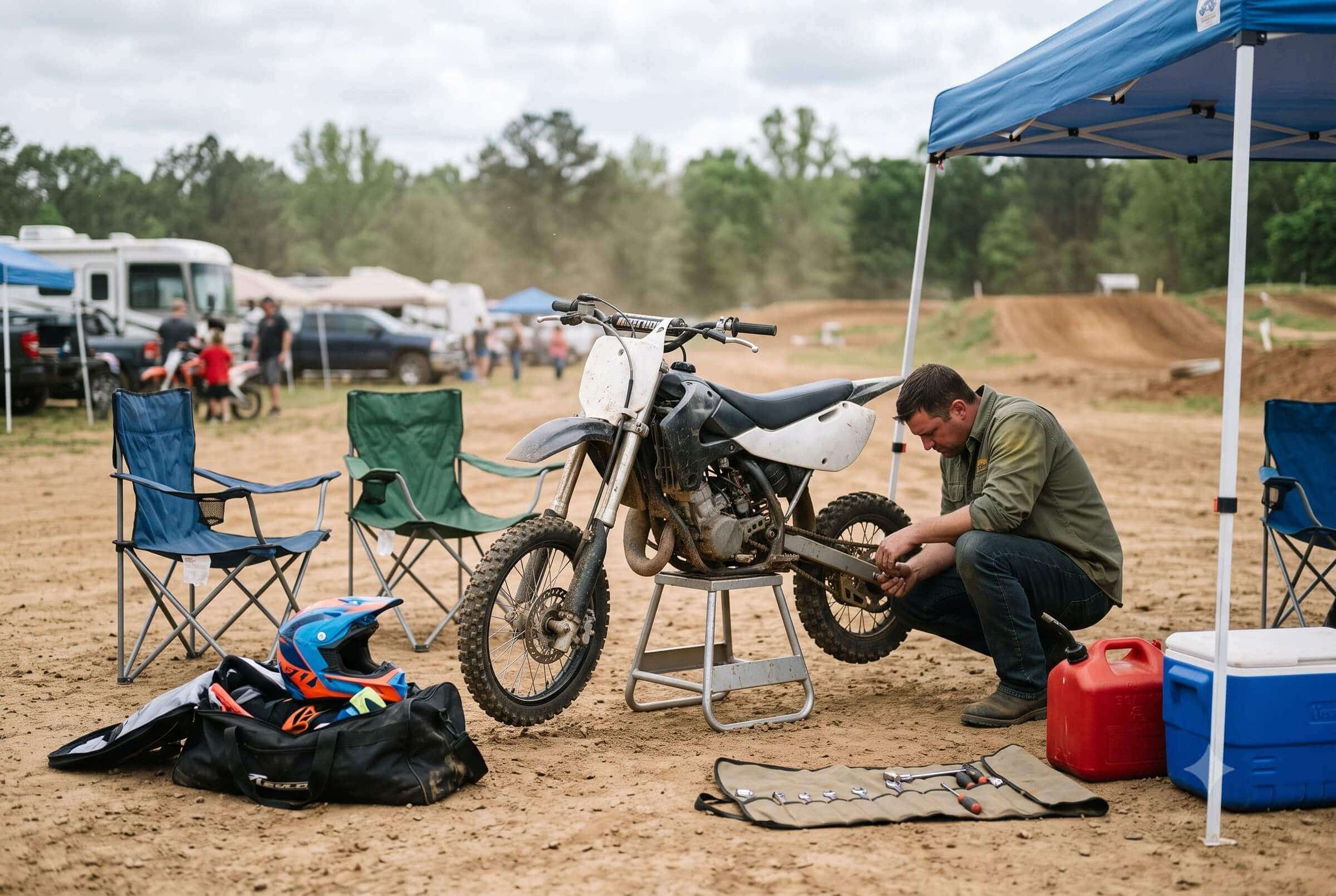
- Fuel for the bike, plus premix oil if it's a two-stroke
- A bike stand and a basic tool roll
- Tire pressure gauge and a pump
- Zip ties and duct tape, which fix more than they should
- A spare set of goggles
- Water, food, sunscreen, and shade — days run long
- Folding chairs, because you'll be standing around more than you expect
Track rules worth knowing before you go
Flags are the language of the track. A yellow flag means something has happened ahead — slow down, don't jump, be ready to change your line. Checkered means the session is over and it's time to come in. Red means stop riding immediately.
Etiquette matters as much as flags, and it's mostly common sense once somebody says it out loud. Look before entering the track. Ride predictable lines rather than swerving. Never stop on the racing line — the fast path other riders are taking through a corner — and if you have to stop, get the bike to the outside edge. Faster riders will come past, and the correct response is to hold your line and let them go around rather than moving unpredictably.
Teach your kid this before their first session. It's the difference between other riders seeing them as a beginner and other riders seeing them as a hazard.
The Part Where You're Scared
Let's name the thing. You're worried your kid is going to get hurt, and you may feel a little guilty for putting them somewhere that's possible. That worry is reasonable and it's shared by nearly every parent standing beside a track.
We won't tell you the sport is risk-free, because it isn't, and any coach who promises otherwise is selling something. What we will tell you is that the amount of risk is not fixed. It moves — substantially — based on how a rider learns.
A rider who learns from friends, from clips online, and from repetition without feedback builds habits under pressure. Some of those habits are wrong, and wrong habits are what fail at the worst moment. A rider who learns fundamentals in sequence, at a pace matched to their ability, builds a different set of reflexes. Body position, throttle control, braking, and vision are safety equipment as much as boots and a helmet are.
There's a framing AJ Catanzaro returns to often in his coaching: fear usually means a skill is missing. When a kid is frightened of a section of track, that's information rather than a character flaw. It tells you exactly which skill to work on next. Treated that way, fear becomes a training tool instead of something to push through and hope. We wrote more on that idea in why the fear never fully goes away.
The practical version for a parent: slow the progression down, get instruction early rather than after something goes wrong, and stop the day when your kid is tired. Fatigue is when the crashes happen.
How Not to Become the Parent Everyone Avoids
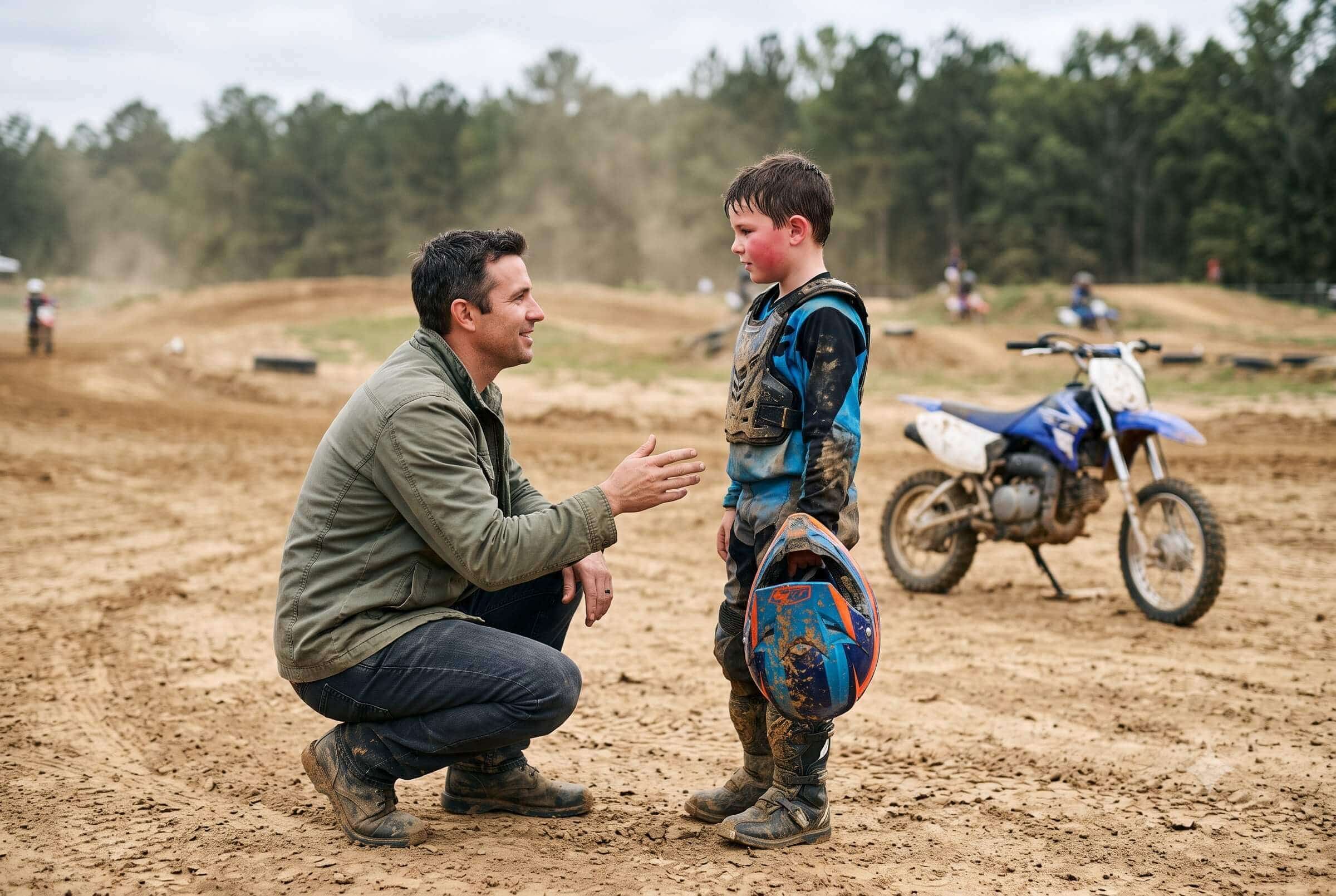
Spend a season at a track and you'll spot them — the parent shouting through the fence, the kid who looks relieved when the session ends. Nobody sets out to become that. It happens gradually, and usually to parents who care a lot.
Here's what the families who last tend to do differently.
They don't turn every ride into a lesson. If every session ends with a list of corrections, riding stops being the thing your kid asked for and becomes the thing you want from them. Some days should just be riding.
They ask about fun before results. The question you ask first tells your kid what you value. "Did you have fun?" and "What felt better today?" produce a different kid than "What place did you get?"
They resist the comparison trap. There's always a kid at the track who's faster, and always a parent happy to tell you what their kid is doing. Progress isn't linear and it isn't evenly distributed. Everyone's path through this sport looks different, and a kid measured against someone else's timeline usually quits.
They separate their expectations from their kid's. This is the hard one, especially for parents who rode themselves. The weight of someone else's expectations is heavy for an adult and much heavier for a nine-year-old.
Burnout in youth motocross rarely comes from too much riding. It comes from too much pressure attached to the riding.
Racing Is Optional
Somewhere in the first year, a parent usually feels a current pulling toward racing — bigger bikes, more weekends, entry fees, a schedule. If that's what your kid wants, it's a great sport to compete in.
It's also completely fine to never race. Plenty of families ride practice days, take classes, go on trail rides, and get everything they wanted from the sport without lining up at a gate. The skills, the confidence, the weekends outside, the time together — none of it requires a number plate.
Let your kid's interest set the pace. If they ask to race, help them race. If they don't ask, riding is the point.
Where Coaching Fits
The most efficient dollar in your kid's first year goes into structured instruction, early, before habits set.
This is what The Moto Academy exists to do. Riders get grouped by ability rather than age, so a cautious eleven-year-old isn't chasing a confident fourteen-year-old — everyone works at a level that fits them. There's one coach for every ten riders, so nobody spends the day waiting their turn. At 5-Day Camps, riders are filmed and then sit down with a coach to watch the footage back, which is where most of the corrections happen. A medical professional is on site all week.
Riders from age 5 to 73 have come through the program, so a nervous first-timer isn't the odd one out.
If you want a low-commitment first step, a 1-Day Class is a single focused day at a track near you — currently $399 in the US and Canada — covering body position, braking, cornering, jumping progression, and mindset. Use the class locator to find a date within driving distance. It's also the cleanest way to answer the "do they even like this" question before you buy a bike.
When you're ready for the full version, the 5-Day Camp is five days of coaching, film study, and mindset work. You can see all the dates and locations on the camps page, and camps are refundable in full up to 60 days out. If your kid isn't ready for five days, a Day Pass drops them into a single day of a live camp.
Between track days, the Moto Academy App has a free tier with a sample course and community access, and members get 20% off classes. It's a reasonable place for a parent to lurk and learn the vocabulary — a lot of them do exactly that.
For more on what the sport does for kids beyond the riding, our kids and families motocross guide covers the mindset side. And if you want to understand what coaches spend most of their time correcting, start with body position — it's the foundation everything else is built on.
What Year One Looks Like When It Goes Well
Twelve months from now, the good version looks like this. Your kid has a bike that fits them and they can pick it up themselves. They know how to check their own tire pressure and chain before a ride. They've got two or three tracks within driving distance and they know which one they like.
They've been coached, so they're riding with their eyes up the track instead of fixed on the front fender, and the things that scared them in month two are just parts of the track now. They've crashed a few times, gotten up, and gone back out. You've stopped holding your breath every lap.
And you've met people. That's the part parents don't see coming — the other families at the track, the ones who lend you a tool and tell you which practice days are quiet. Riding around other people turns out to accelerate progress more than almost anything else.
"I was nervous about putting my daughter on a dirt bike," says Lisa, a mom from Michigan. "But after our first Moto Academy class, I knew she was in good hands. The coaches weren't just showing her how to ride — they were showing her how to think. She came home saying, 'Mom, I stayed calm and crushed it.' That confidence is priceless."
The version that goes badly usually isn't dramatic. It's a bike that never fit, bought before anyone knew what size to get. It's a kid who learned to be frightened before they learned to be skilled, and a family that quietly stopped going. That outcome is avoidable, and the fork is early.
Your Next Step
If you take one thing from this guide: get your kid coached before you get them a faster bike. The simplest way to start is a 1-Day Class near you — one day, one track, no bike purchase required.
If you're already sure and want the full week, look at 5-Day Camp dates, or book a free call with a Camp Advisor and talk it through with a person first.
Your kid asked for a dirt bike because they want to feel capable. Everything above is just the order of operations for getting them there in one piece.
Disclaimer
This article is for general information and reflects the practices and opinions of The Moto Academy. We are not medical or legal professionals. Motocross carries an inherent risk of injury. Verify local laws and land-use rules before riding, research all safety equipment thoroughly, and consult a physician before your child begins any new sport.